China
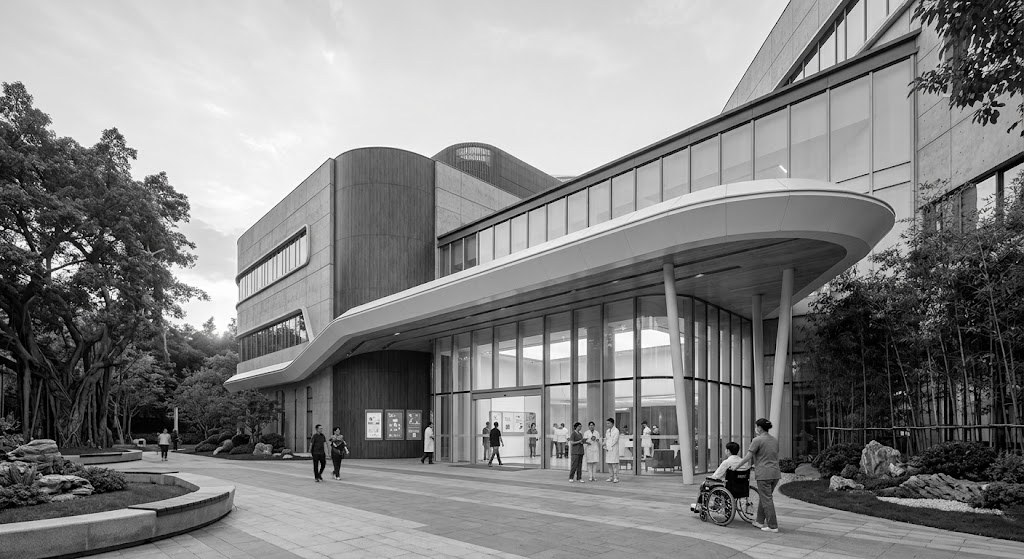
China’s best hospitals are public.
The care Chinese families compete for is in the university hospitals, not the private clinics. It is reached through a tier most visitors never hear about.
Which makes the usual shortcut useless here. Accreditation sorts for private facilities, and the hospitals that matter are the ones it leaves out.
Accreditation
Why the badge points the wrong way.
JCI has largely withdrawn from China. A small number of private facilities hold it, Shanghai Jiahui among them, partnered with Massachusetts General[S18].
The hospitals Chinese patients actually queue for are public Grade 3A university hospitals: Peking Union, Shanghai Ruijin, Fudan University Shanghai Cancer Center, West China in Chengdu[S19].
So the useful question changes. It stops being whether a hospital is accredited, and becomes which tier you are entering and which department you are under.
The three tiers
Three doors, one set of doctors.
The same senior specialists rotate through all of them. What changes is access, language and waiting, which is most of what a foreign patient is buying.
- 01
General Department普通部
A specialist consultation costs around ¥50. Slots are contested, imaging can wait one to four weeks, and wards are shared. Without fluent medical Chinese it is not a realistic route.[S20]
- 02
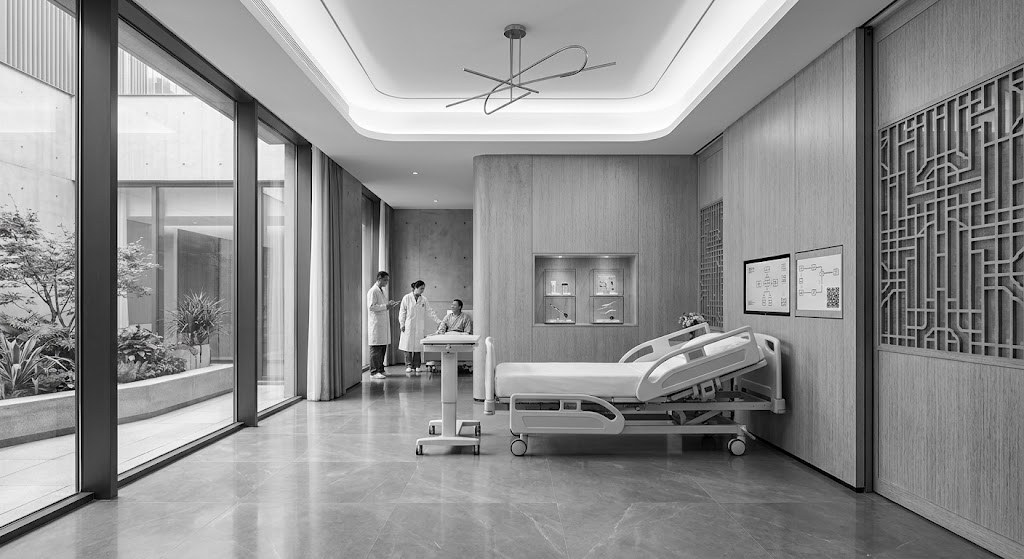
International Department国际部
Booking by phone or email with dedicated coordinators, waits under thirty minutes, same-day imaging often possible. Registration runs ¥1,000–1,500 at a major Beijing tertiary hospital, against ¥50–100 at the general clinic, and surgery fees reach several times the general rate. Senior specialists at the top of the tier can list far higher: Fudan Obstetrics and Gynecology in Qingpu publishes ¥5,000 for one gynaecological oncologist, self-pay only.[S20]
- 03
Private international hospitals
English by default and direct insurance billing. A GP visit runs ¥620–1,530, about $85–210. Jiahui, United Family and Parkway are the names you will meet first.[S21]
The International Department is the functional way in. You are paying for access, English and coordination, and meeting the same specialists.
Where China leads
What it is genuinely good at.
- Speed
- Routine diagnostics inside about three days, and major surgery often within one to two weeks, on the back of the largest patient volumes in the world.[S22][S23]
- Particle therapy
- Around ten operating proton and heavy-ion centres with more than sixty planned by 2030. Only six countries run carbon-ion therapy at all — Japan, Germany, Austria, Italy, China and South Korea. The United States runs none.[S24][S25]
- Oncology depth
- Fudan Shanghai Cancer Center, PUMCH and Sun Yat-sen carry caseloads in liver, gastric, oesophageal and nasopharyngeal cancer that few centres anywhere can match.[S19]
- Boao Lecheng
- China's only medical special zone, cleared to use FDA and EMA-approved drugs and devices before national registration. 413,700 medical visitors in 2024, up 36.8%, with approvals running three to seven days.[S29]
Indicative prices
What it costs.
Indicative ranges in US dollars, September 2026. International Department pricing typically runs two to five times the general rate, and every figure moves with the case.
- IVF, two-cycle package≈ $8,300¥60,000, private international tier[S30]
- Dental implant$280–3,500international tier around $1,400 per tooth[S31]
- Spinal fusion$7,000–12,500¥50,000–90,000; complex revisions to about $21,000[S32]
- Joint implant hardware$700–970the implant alone, after centralised procurement; surgery package $9,000–15,000[S33]
- Coronary bypass (CABG)≈ $40,000all-in at a Shanghai tertiary international department; a market anchor rather than a quote[S54]
- Knee replacement$8,000–12,000international tier; one patient account puts a Shanghai hip at a little over ¥30,000[S55]
- Solid-tumour CAR-T≈ $137,000¥990,000 a dose, approved in China and not yet elsewhere[S57]
- Cancer, brain tumour course≈ $7,500six weeks, ¥54,000[S34]
- Cancer, lung$21,000–35,000by stage and drug regimen[S34]
- International Department registration$140–210¥1,000–1,500 at a major Beijing tertiary hospital, against ¥50–100 at its general clinic[S20]
- Zhongshan Shanghai, cardiac chief physician≈ $165¥1,200 to register, ¥800 with an associate chief physician, plus ¥300 to request a named doctor on a return visit[S58]
- Zhongshan Shanghai, inpatient night≈ $890¥6,400 self-pay, or ¥3,800 with a commercial insurance discount[S59]
Who this is for
A poor way to save money.
Add a return flight, one to four weeks of accommodation, someone travelling with you, translation and a contingency, and the saving on a routine elective procedure lands around 20 to 30 percent. From short-haul Europe it can fall below 20[S56]. For a knee, that is not worth the flight.
The reason to come here is something you cannot get at home, or cannot get soon enough.
- Treatment approved here first
- The first approved CAR-T for solid tumours is licensed in China and nowhere else, at ¥990,000 a dose[S57]. Shanghai Jiahui’s cancer centre treated the first international patient to receive it, and reports CAR-T patients from twelve countries since 2023[S60]. Proton and heavy ion sit in the same category[S24].
- Complex cases, where volume counts
- Surgical caseloads at the top Chinese centres run several times those of comparable Western hospitals, and the hardest operations are where that gap shows[S19].
- When the alternative is waiting
- Diagnostics inside about three days and surgery often within one to two weeks. If the choice at home is a queue measured in months, the arithmetic changes[S23].
Proton and oncology
Proton therapy and cancer care.
China runs one of the largest proton and heavy-ion networks anywhere, and the Shanghai Proton and Heavy Ion Center has held a flat published rate since it opened in 2015[S26].
Its published figures also show why a single headline price misleads: ¥278,000 is the flat radiotherapy fee, and roughly ¥330,000 the average total once everything else is counted[S26].
Capacity, indications and centre-by-centre pricing all move quickly, and the English material thins out fast. We obtain quotes directly from the centres instead.
Request a proton therapy assessmentGetting in
Before you travel.
- Visa
- S1 for stays over 180 days, S2 under. A hospital invitation letter is required, and proof of funds above 120% of estimated costs is enforced strictly for Hainan and Lecheng.[S35]
- Timeline
- Two to four weeks to admission for international particle-therapy patients.[S26]
- Records
- Pathology slides, imaging as DICOM, and full treatment history, for multidisciplinary review before you travel.[S35]
- Language
- International Departments provide interpreters, commonly English, Japanese, Russian and Arabic. Outside that tier a coordinator is effectively required.[S20]
- Payment
- Pay-per-step even in VIP departments. Direct billing with international insurers is supported at more than 80% of top hospitals in this tier.[S20]
What we will not arrange
Two things to know first.
- Cosmetic limb lengthening
A 2006 Ministry of Health regulation limits limb-lengthening surgery in China to congenital deformity, trauma, tumour or infection that has caused a leg-length discrepancy. Height gain on its own is not a lawful indication[S50].
A market operates anyway, quoted between ¥100,000 and ¥1,000,000, with former patients paid commissions of up to ¥80,000 for bringing in the next one. Reported outcomes include unequal leg lengths and patients left unable to stand[S53].
China’s reconstructive limb surgery is excellent and we will help you reach it. Cosmetic height lengthening here we leave alone.
- Commercial stem cell therapy
Outside haematopoietic transplant, stem cell therapy in China sits at the clinical research stage. The National Health Commission’s rules say institutions may not charge subjects for it and may not advertise it[S52].
In March 2026 a Chengdu prosecution set out what the commercial version looks like: ¥38m taken from more than 1,900 elderly patients, preparations sold at ¥9,980 to ¥79,800 that were largely vitamin C, saline and glutathione costing under ¥100, and nurses altering follow-up data to show improvement[S51].
Any clinic selling it as a treatment is outside the rules. Knowing that is the service.
Source transparency
Where these numbers come from.
This page is our own research, not a guarantee. English-language pricing from Chinese hospitals is thin and often promotional, and we would rather show our working than claim certainty we do not have. Every figure carries a reference to the reference list, and the registry says plainly which entries are still to be confirmed against a primary document. For any client we obtain a written hospital-direct quote before anything is committed — in China more than anywhere.
Request a case assessment